From Free Body Diagram to Equations
A finished diagram is half the job. This is the translation step — arrows into equations — plus the two choices, axes and moment point, that decide whether the algebra takes three lines or thirty.
Tilt the axes to match the motion, and take moments where the unknowns meet. Those two choices do most of the work.
The equations
For a body in equilibrium, at rest or moving at constant velocity:
- ΣFx = 0
- ΣFy = 0
- ΣM = 0, about any point you like
For a body that is accelerating:
- ΣFx = m·ax
- ΣFy = m·ay
For a particle, that is the entire toolkit. A rigid body adds a third, ΣMG = IG·α, taken about its centre of mass G — not any point you like — and ax, ay are then the acceleration of G. Every problem is these applied to a correct diagram.
1 — Point an axis along the motion
- Flat ground — ordinary horizontal and vertical.
- An incline — tilt them along and into the slope. Then usually only the weight needs resolving, into mg sin θ and mg cos θ, while N, f and the tension T in a rope along the slope already lie on an axis.
- Circular motion — point one axis at the centre.
2 — Resolve what is left
A force F at angle θ from the x-axis contributes F cos θ and F sin θ. Write those beside the arrow on the diagram itself; it is where sign errors get caught.
Fix your positive directions once — right, up, counter-clockwise — and do not change them part way through.
3 — Walk the diagram
Go arrow by arrow. Each one appears in ΣFx and ΣFy exactly once, with a sign from your convention. An arrow that never appears, or appears twice, means the diagram and the algebra have come apart.
4 — Choose the moment point deliberately
A moment is force times the perpendicular distance to its line of action, counter-clockwise positive. The answer is the same whichever point you pick — the effort is not.
Take moments where the most unknowns intersect: they drop out of the equation entirely.
On a simply supported beam, taking moments about the pin removes both pin reactions at once, leaving one equation with one unknown. Solve for the roller reaction, then let ΣFy give you the rest.
5 — Count before you solve
- A particle in 2D — two equations, so up to two unknowns.
- A rigid body in 2D — three equations, so up to three unknowns.
- More unknowns than that — isolate another body, which brings two or three more equations. If that still is not enough, the structure is statically indeterminate.
Worked example: block sliding down a rough incline
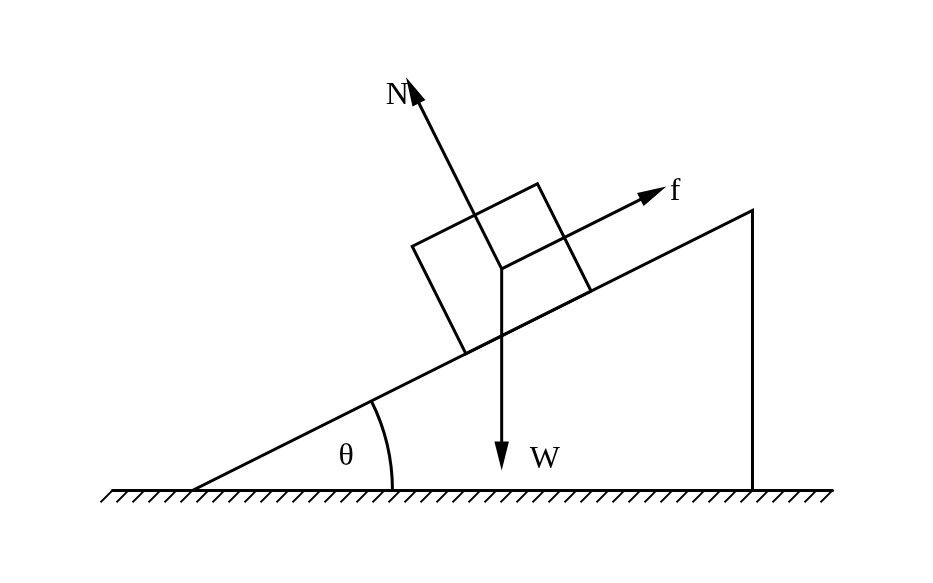
Weight mg down, normal N perpendicular to the slope, kinetic friction f = μkN up it. Axes tilted along the incline, positive down-slope:
- Along the slope — mg sin θ − μkN = m·a
- Perpendicular to it — N − mg cos θ = 0, so N = mg cos θ
- Substituting — a = g(sin θ − μk cos θ)
Two unknowns, two equations, three lines of algebra — because the axes were tilted and the diagram was complete before any of it started.
FAQ
Does it matter which point I take moments about?
Not for the answer, very much for the work. Pick a point that sits on the line of action of the unknowns you would rather not deal with, and they vanish from the equation.
Can I use more than one moment equation?
Yes. In 2D you can trade a force equation for a moment equation about a different point, up to three independent equations in total. Sometimes it is much faster.
What if I end up with 0 = 0?
The equations were not independent — usually a moment point that eliminates everything you had already solved. Pick a different point.