Types of Supports and Their Reactions
When you isolate a beam or a frame, each support is replaced by the reactions it can provide. How many reactions each one gives decides both what your diagram looks like and whether statics can solve the structure at all.
Count what the support stops. Each direction it prevents movement in is one unknown reaction.
The five supports
Movement perpendicular to its surface, and nothing else.
It rolls along the surface and rotates freely, so the one direction it resists is the one it can push in.
Movement in any direction. Rotation stays free.
The reaction can point any way, which is why it takes two components to describe it.
Movement in any direction, and rotation as well.
Forgetting the reaction moment M is the single most common mistake on a cantilever.
Movement along its own axis.
A cable can only pull. A rigid two-force link can push or pull.
The body passing through the surface.
Same as a roller: one force, perpendicular to the surface at the contact point.
Can statics solve it?
A flat rigid body gives you exactly three equilibrium equations — ΣFx = 0, ΣFy = 0 and ΣM = 0. See From Free Body Diagram to Equations for writing them. Add up the unknowns and compare against that three:
- Exactly 3 — statically determinate, solvable with statics alone, as long as the three reactions are not all parallel and their lines of action do not all meet at one point. A pin plus a roller is the classic case: 2 + 1 = 3.
- More than 3 — statically indeterminate. You need deformations, which is mechanics of materials, not statics.
- Fewer than 3 — not a structure at all. It is a mechanism, and it will move.
Worked example: simply supported beam
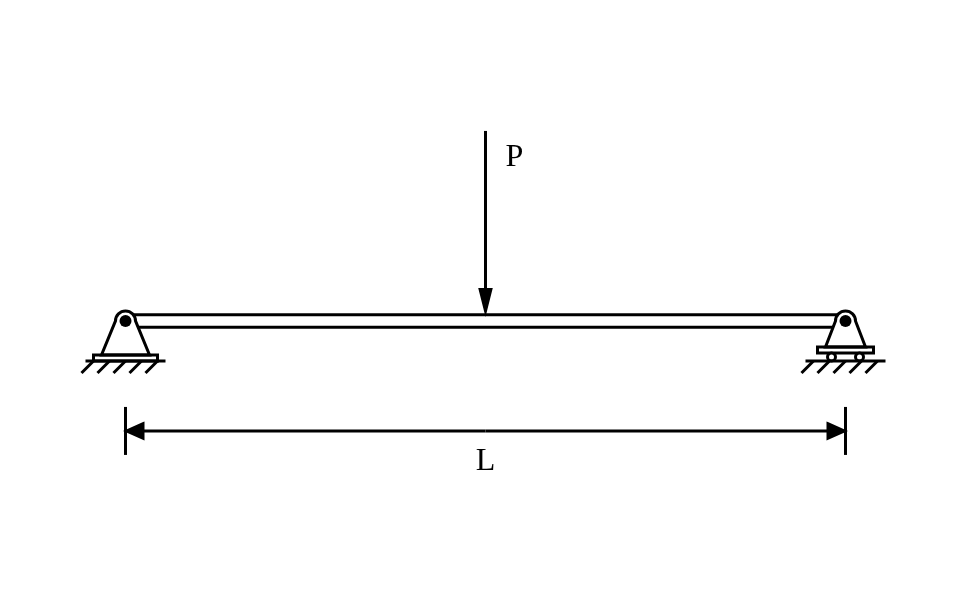
- Isolate the beam and draw it as a line.
- Replace the pin with Ax and Ay, and the roller with By.
- Add the load P pointing down.
- Three unknowns against three equations, so it is determinate. ΣFx = 0 gives Ax = 0; moments about A give By; ΣFy = 0 gives Ay.
FAQ
What is the difference between a pin support and an internal hinge?
A pin support ties a member to the ground and gives two reactions. An internal hinge joins two members to each other: it passes force but no moment, and it hands you an extra equation, ΣM = 0 at the hinge for either side.
Why does a roller only have one reaction?
Because rolling and rotating are both free. The only motion it stops is perpendicular to its surface, so that is the only direction it can push.
Which way should I draw a reaction I do not know yet?
Either way. Pick a direction, solve, and read the sign: a negative answer means the reaction points the opposite way to the arrow you drew.