What Is a Free Body Diagram?
A free body diagram (FBD) is a sketch of one object, cut free from everything touching it, with an arrow for every external force acting on it. You draw the object, you draw the forces, you label them. Nothing else goes in.
Isolate one body. Show every external force on it. Show nothing else.
Why it matters
ΣF = ma, and the equilibrium equations ΣF = 0 and ΣM = 0, are only correct if you have accounted for every force — no more, no less. The diagram is where that goes right or wrong, before any algebra starts.
- A forgotten friction force is the most common wrong answer in statics.
- An invented one — a “force of motion” pushing the object along — is the next.
- Directions and angles become explicit, so the equations follow from the picture.
What goes in one
Three parts, and only three:
- The body — a box, a dot, or a rough outline. It does not need to look like the object.
- Force arrows — each starting on the body, pointing the way the force acts, roughly scaled to its size.
- Labels — W or mg for weight, N for normal force, T for tension, f for friction, plus a value when you know it.
Engineering diagrams add support reactions, distributed loads, moments and dimensions. Still the same three parts.
Isolating the body
This is the step the name refers to, and the one people skip. Start with the scene: a book sitting on a table.
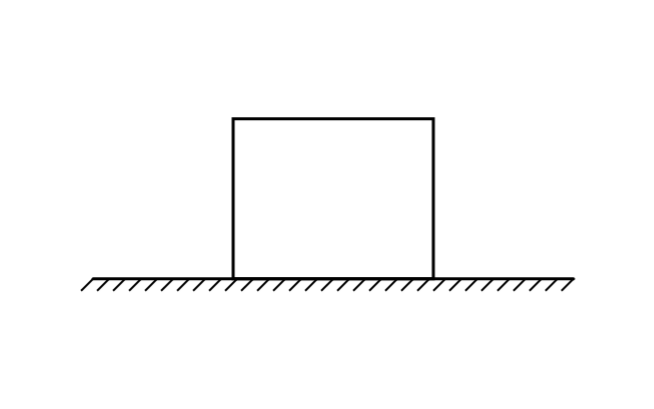
Now remove the table. It does not appear in the diagram; what appears is the force the table pushed back with.
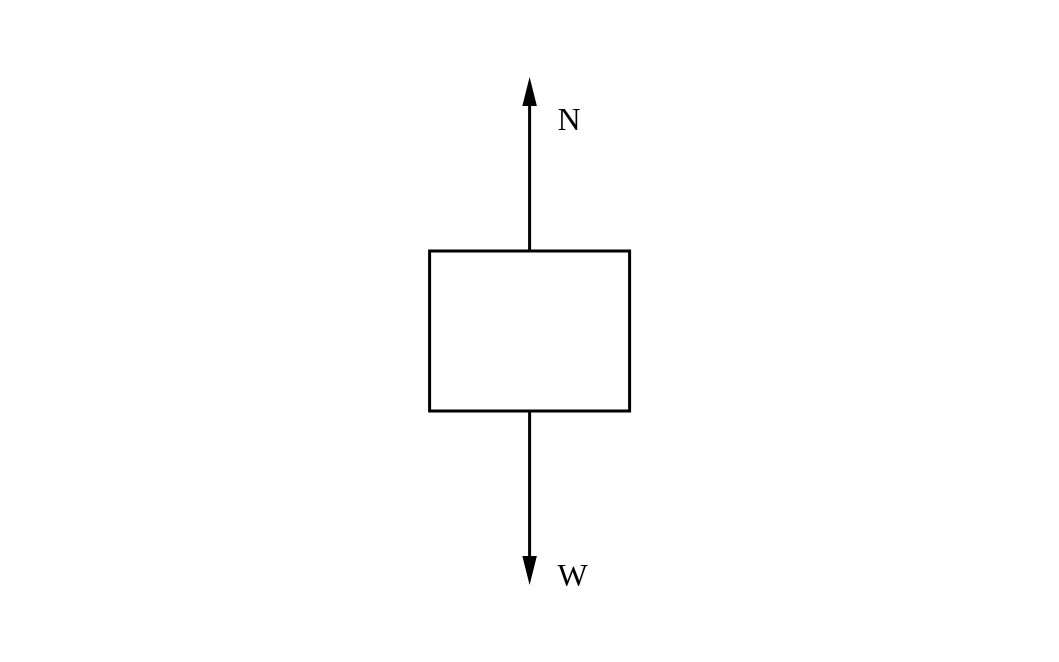
Trading a surface for the force it exerts is the whole technique. Because the book is not accelerating, the two arrows must cancel: N = W. One equation, straight off a two-arrow sketch. The next guide walks through drawing one step by step.
Free body diagram or force diagram?
The terms get used interchangeably. Strictly, a force diagram may show forces on several objects at once, while a free body diagram isolates exactly one body — or one group of parts treated as a single body. In coursework, “draw the FBD” always means isolate first.
FAQ
Do internal forces appear on an FBD?
No. Only external forces acting on the body appear. Internal forces, between parts of the same body, cancel in pairs and are left out.
Does the FBD need to be to scale?
No, but arrow lengths should roughly reflect relative magnitudes, and angles should be accurate enough to label correctly.
What’s the difference between an FBD in physics and in statics?
Same concept. Physics problems usually use dots and blocks; statics adds supports, distributed loads and reaction moments for structures.